The Sandretto Re Rebaudengo Foundation on the island of San Giacomo will be closed from August 1 through August 31. From September 1 through September 12, visits in San Giacomo will be available only by booking a guided tour. The exhibitions will close on September 12th and the program will resume in 2027.
Guided tours for organized groups
Guided tours for organized groups (minimum 10 and maximum 25 participants) can be booked by writing to venezia@fsrr.org
Reservations must be made at least ten days in advance; your preferred date may not be available.
Opening hours are from 10:00 a.m. to 4:00 p.m. (last admission).
Prices:
– Admission and guided tour in Italian: €350
– Admission and guided tour in English: €400
Time spent on the island is limited to the duration of the guided tour (90 minutes).
PRACTICAL INFORMATION
At present, San Giacomo Island is not served by public transportation; therefore, transportation to and from the island must be arranged and paid for by visitors. On days open for self-guided visits, landing on the island is permitted, but mooring private boats is not allowed.
There are currently no bar or cloakroom facilities available on the island.
Please be advised that, starting September 12, when the exhibitions close, San Giacomo Island will no longer be accessible.
Fanfare/Lament is a multidimensional, site-specific installation that emerges from Matt Copson’s (Oxford, UK, 1992) engagement with the Island of San Giacomo and his desire to work with the site’s natural forces. In particular, the artist chose to interact with air currents, envisioning a choreography directed by the wind and composed of three elements: a series of airborne sculptures rising above the roofs of the two Polveriere (Powder Magazines), indoor laser projections, and a fanfare performed by a group of musicians.
For the project, Copson devised two types of airborne sculptures, made from handcrafted kites designed and produced specifically for the occasion. The first depicts a series of disembodied eyes that gaze down at the public and the lagoon, activating an exchange of looks with visitors: the eyes look at us, and we look back at them. The second, a single and larger piece, takes the form of a hollow black body. These sculptures dance to the rhythm of the wind, producing a sound reminiscent of the buzzing of a swarm.
At the same time, a fanfare commissioned from British composer Oliver Leith is performed outdoors by a group of seven musicians, welcoming visitors as they arrive on the island. The fanfare calls for our attention at regular intervals: if we are lost in thought or conversation, the sound of the trumpets brings us back to the present moment and reconnects us with the outside world. Just as the eye-shaped sculptures invite us to look, the fanfare asks us to listen.
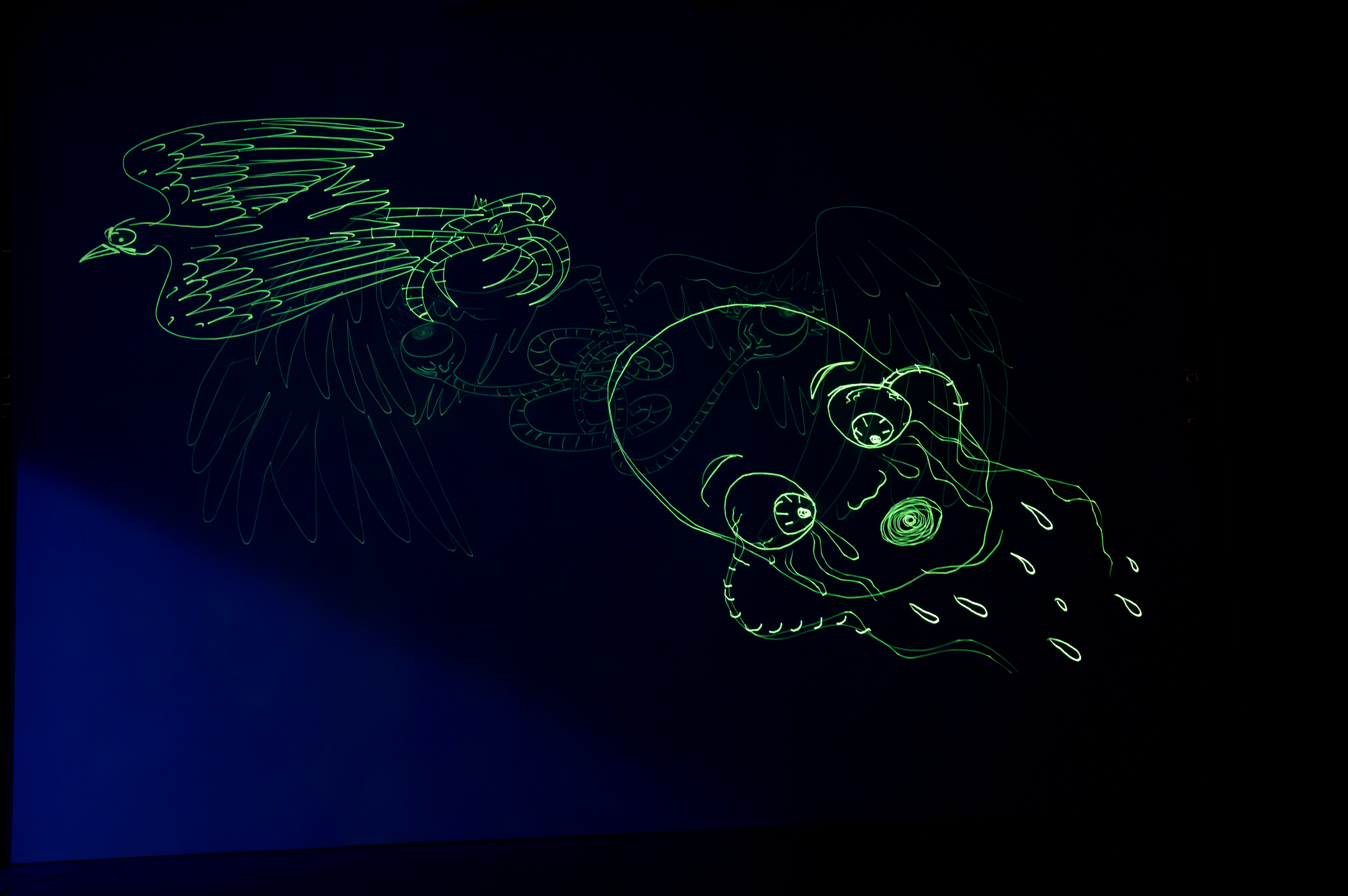
Inside Polveriera EST, four laser animations move across the walls, completing the choreography. The walls are coated with phosphorescent paint capable of absorbing light and re-emitting it with a delay, allowing the beams to leave luminous trails behind them—like spectral traces lingering on the surface. In the dark space, laser light assumes the same role that wind plays outdoors: a non-human agent that, within a broader choreography spanning the island and its forces, exerts power over us and directs our attention.
Attention is a key theme in Copson’s practice and plays a central role in this project. The artist has consistently resisted the musealization of art, which in his words produces “dead images and objects.” Instead, he favors more vital solutions, beginning with the use of laser animation, which he has long employed in his installations. While traditional projections create movement through the rapid succession of static images, laser projectors contain very fast motors that physically trace figures through motion. As a result, the animated characters that recur in Copson’s work—a fox, a child, a skull—are truly in motion and retain their own vitality. Through the polarized light of a laser beam, they are continuously redrawn: chasing their own tails, they never complete their form and remain suspended in an infinite present.
This desire to create living art is closely linked to theater. Copson recently collaborated with Oliver Leith on the opera Last Days, critically acclaimed and staged at London’s Linbury Theatre in 2025 and 2022. This interest also resonates in his project for the Venetian context, where the eye-shaped sculptures inevitably evoke another form of theater: the swarms of eyes that, during Carnival, move through the city behind painted masks. Copson is fascinated by the image of eyes as animated protagonists of Carnival, and their power to attract and direct attention has made them a recurring motif in his sketchbooks and drawings over the past decade.