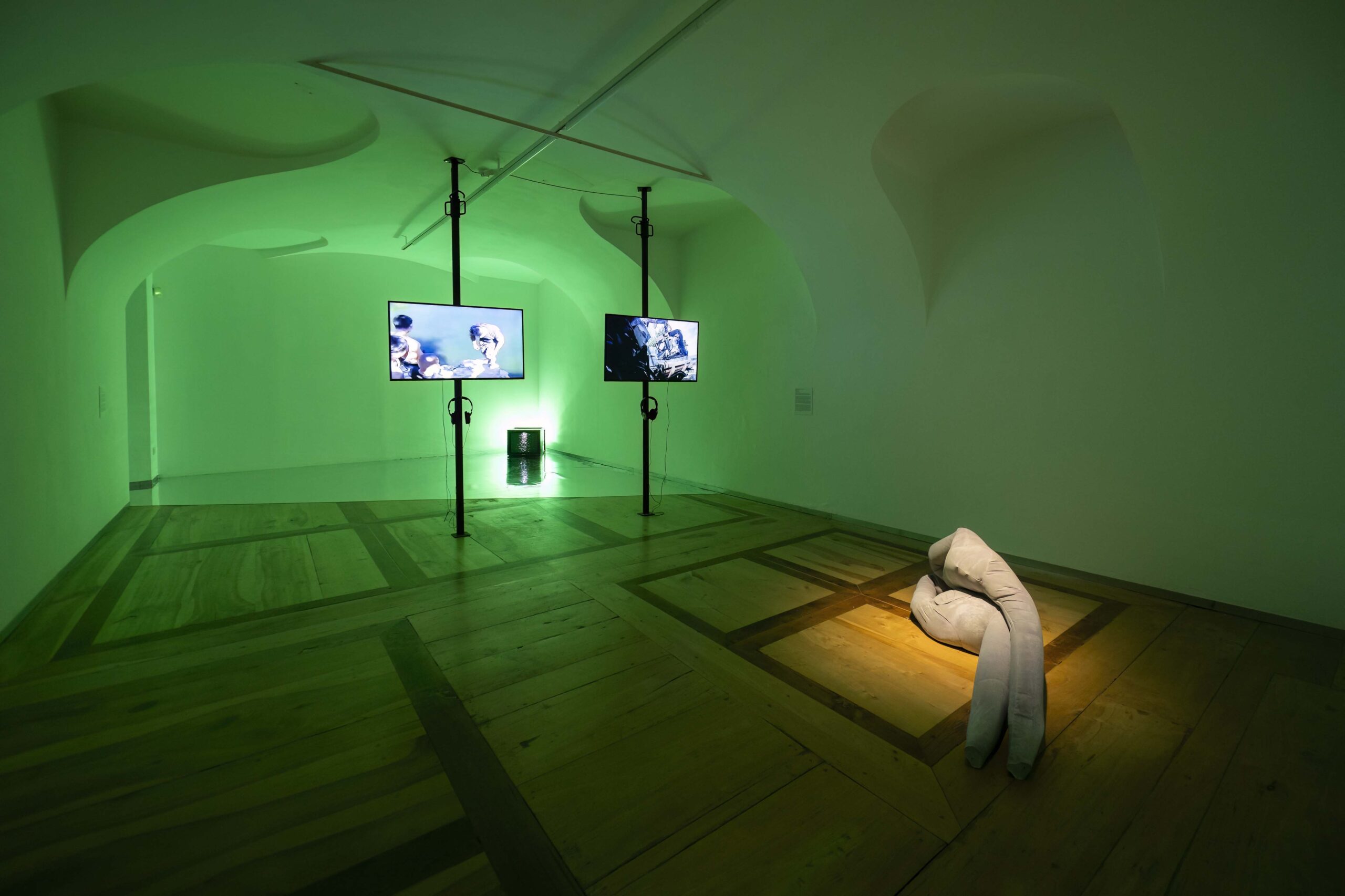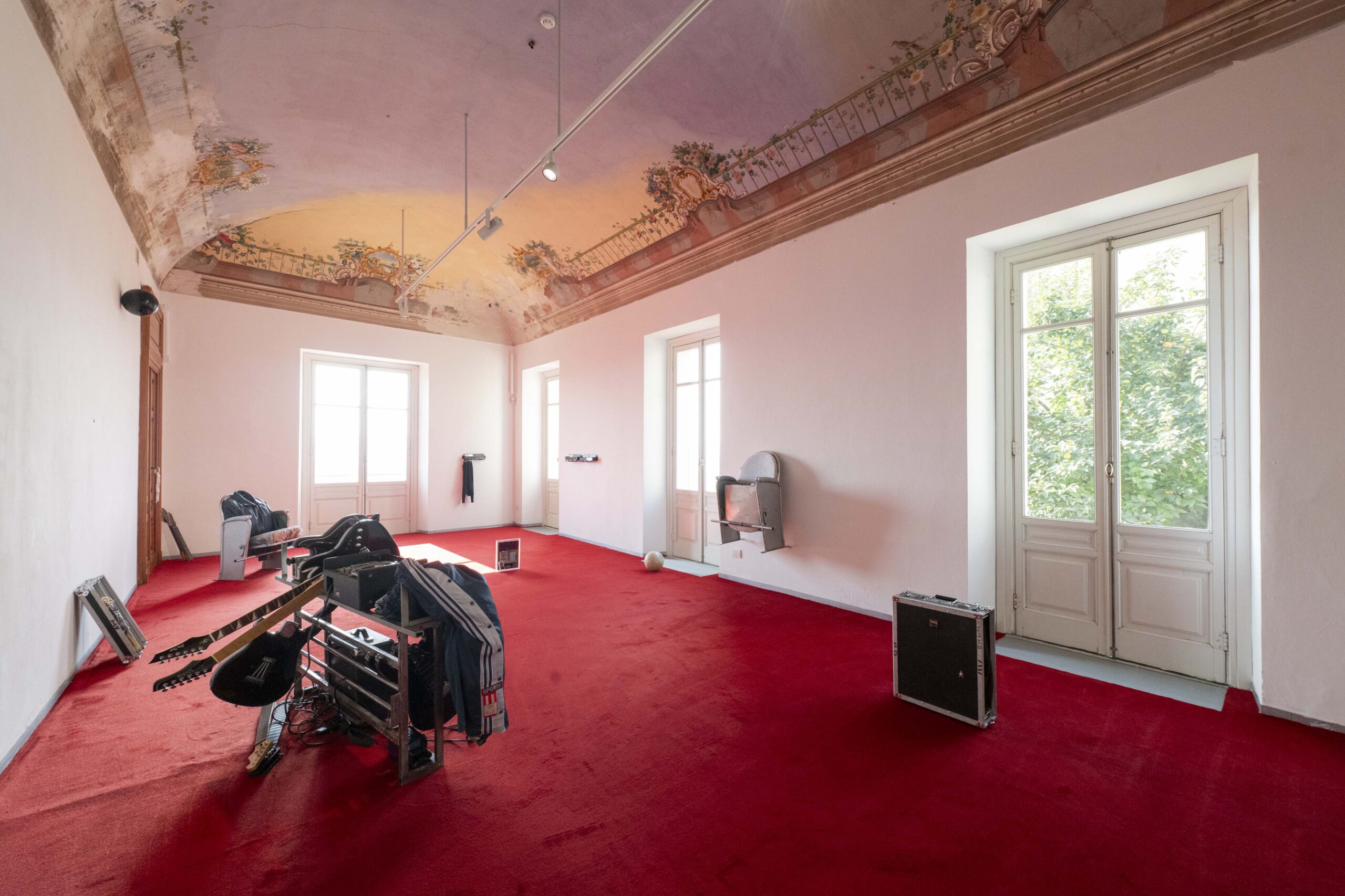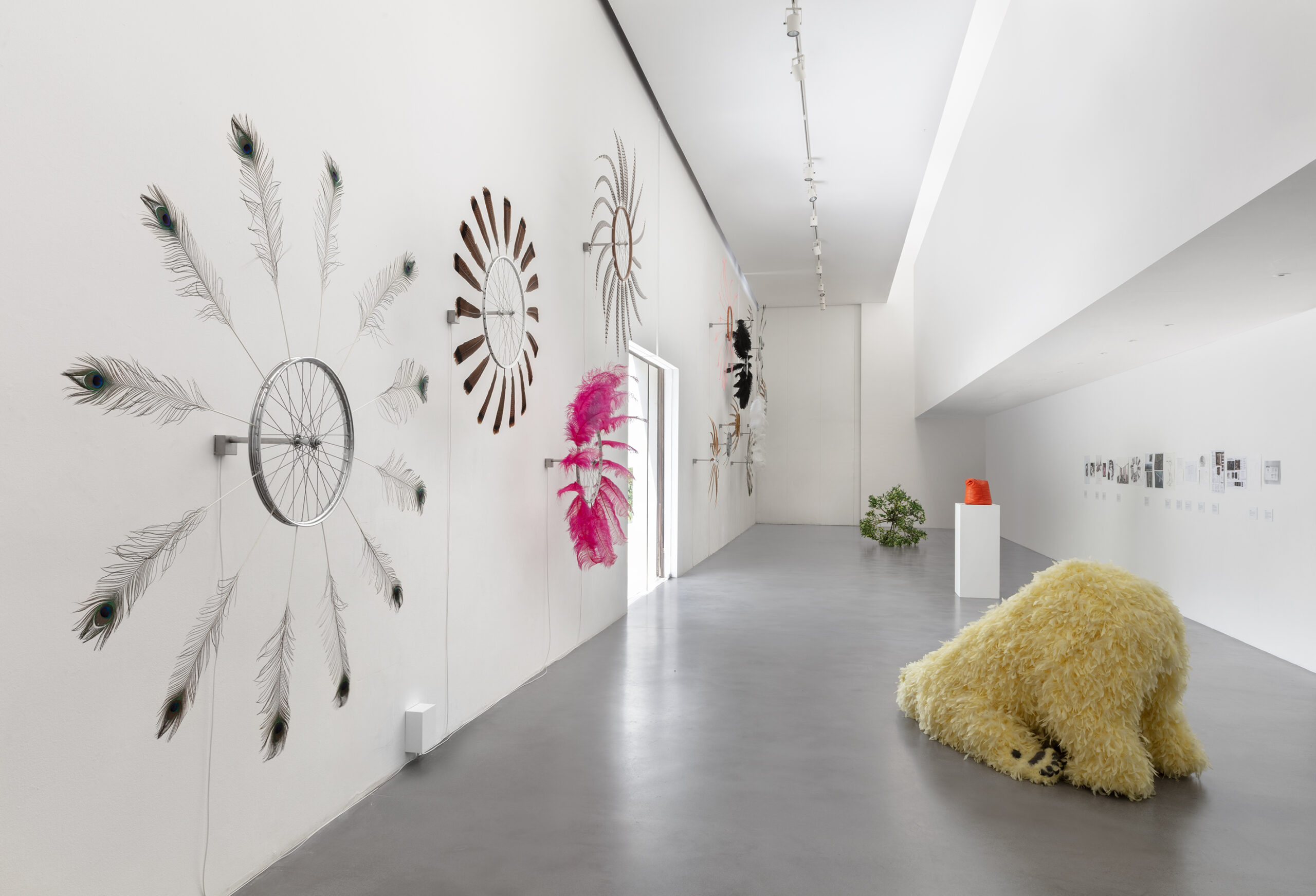
Fondazione Sandretto Re Rebaudengo presents Danzante, the first solo exhibition in an Italian institution by June Crespo. The artist conceives her sculptural assemblages as communicating vessels that resonate within the bodies of visitors. Sometimes delicate, at other times energetic, the installations always emanate a vital and lively quality.
Most of the works in Danzante derive their formal vocabulary from the shapes of iris flowers and birds of paradise, although the artist does not aim to faithfully reproduce these plants. Their appearance serves as a starting point for a deeper engagement with materiality and the evocative potential of surfaces and textures, which take precedence over the pictorial dimension in her practice. Crespo treats her materials as agents, considering herself an assistant to her work rather than an authoritative figure. In this way, she offers a visceral experience: an encounter with objects that touch us in our corporeality and heighten our awareness of being present and in a fragmented condition.
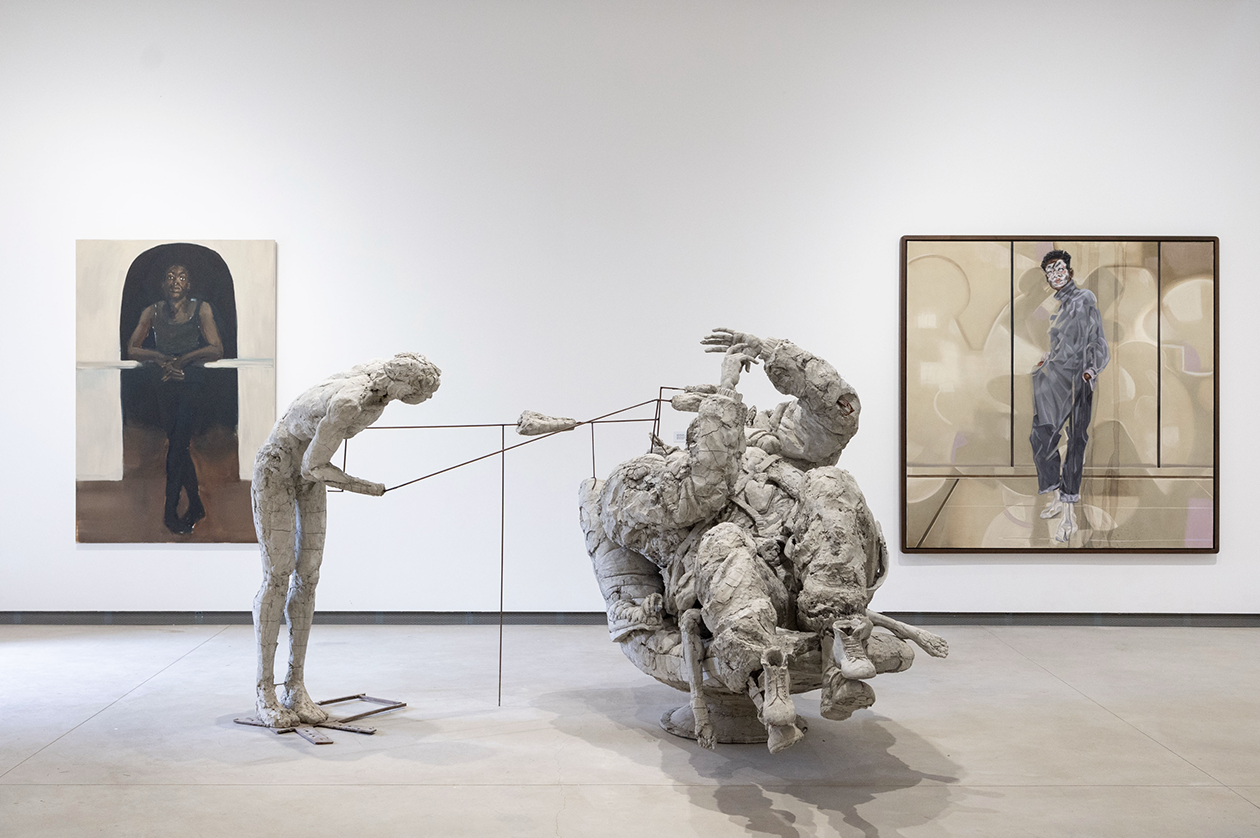
It is only by moving around the works that one begins to establish a relationship with them. Fundamental to this experience is the choreography of objects within the exhibition space—an environment to which they respond through their weight, proportions, and methods of suspension. This spatial construction allows the artist to compose unusual associations between architectural space and the body, between flesh and stone—elements that, in Crespo’s practice, are conceived not as distinct entities but as intertwined. Some objects extend vertically, rising as we move through the exhibition, while others emphasize their connection to the ground. Some sculptures adhere to human scale, while others stretch above our heads through the ceiling.
The materials and their interrelations also echo intimate bodily sensations, such as those experienced by the palate and tongue or the eyelid and the eye in a given moment.
Crespo creates casts and molds—particularly of organic elements such as flowers—in plaster, bronze, or concrete, also using 3D scanning, a high-tech mode of production and representation that separates objects from any kind of natural order. She plays with enlargement and fragmentation, and her works feature a variety of surface structures, often abject, raw, or encrusted. She combines molds and casts with found textiles or industrial construction elements, as well as with her own garments, selecting objects especially close to the body to add an intimate dimension to the work. Industrially produced elements evoke building facades and their systems of drainage and air conditioning.
By combining the organic and the technical, Crespo’s art not only reflects on the pressure and destruction inflicted on nature by post-industrial production, but also activates a process of repair through the recomposition of fractures between things that, though seemingly unrelated and disconnected, are constructed and reconstructed through alternative practices of connection.
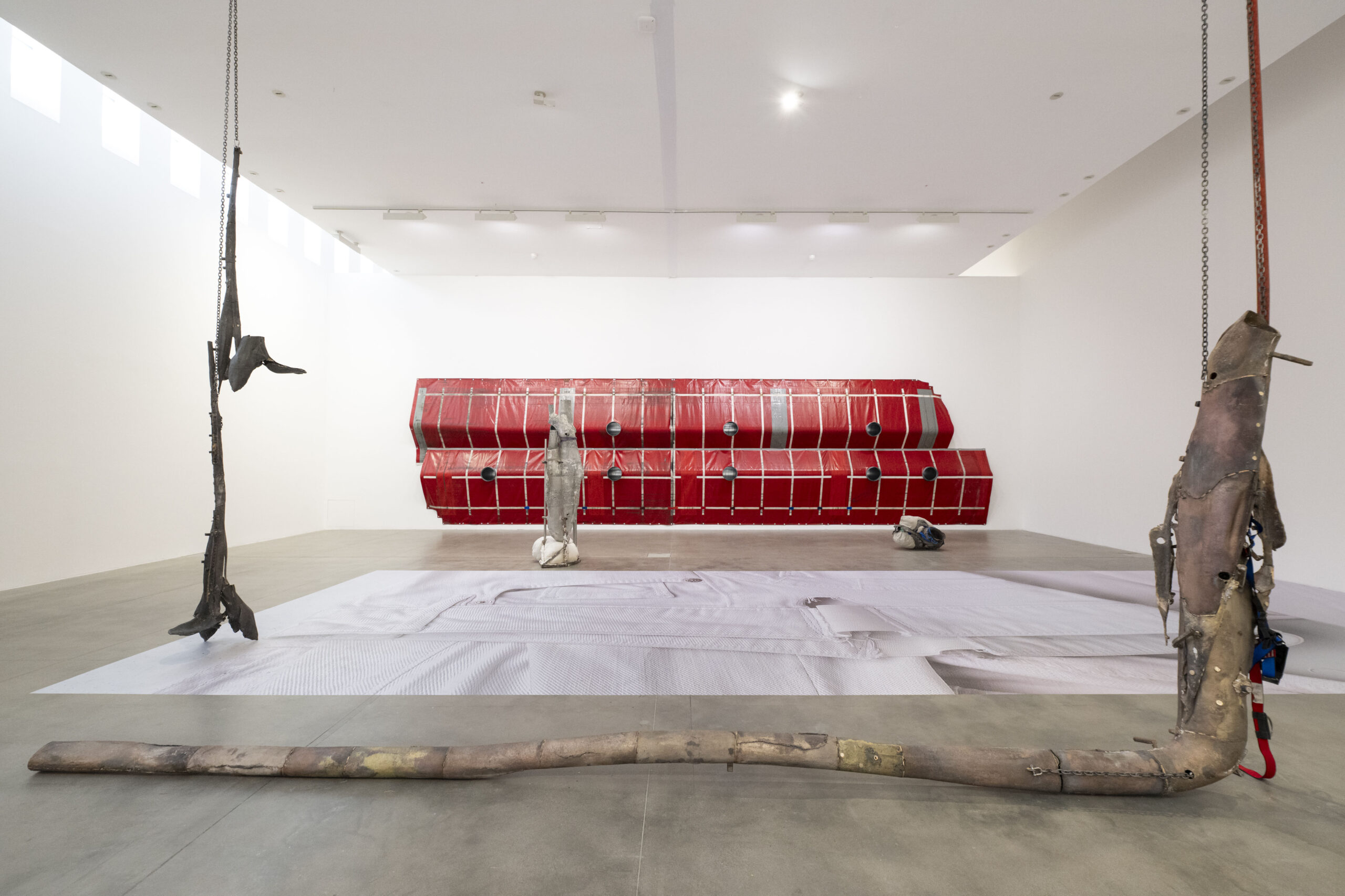
In Molar (2024), bronze, steel, and fabric intertwine to form a complex entity that suggests both a sense of constraint and of embrace. The Dancing Column II (2025) consists of two concrete pillars nested within one another; they might appear monumental if they were not placed so delicately on a voluminous cushion. The horizontal work TW, TG 2025 III (2025) is made from reclaimed industrial tarpaulins the size of a trailer truck. The sheets are arranged in a geometric grid and pierced by tubes that create an irregular pattern of holes. Through this technique, the artist recalls the industrial functionality of objects while emphasizing the suggestion that the material vibrates along with breath.
Repetition is a central motif in Crespo’s intuitive and experimental process. The artist consciously shapes materials into paradoxical poses of encounter and separation, creating tension, friction, and contrast. These bodily units are never static but appear to be in motion—body-objects in transition. In the artist’s words: “I do not want to cement an image, but to propose an encounter between bodies in the interval. My aim is to relate things freely, so that the arrangement does not feel forced. If the works are free, the viewer is freer too.”
June Crespo was born in Pamplona, Spain, in 1982. She lives in Bilbao, Spain.
The exhibition Danzante by June Crespo has been developed and co-produced in close collaboration with Secession in Vienna, Fondazione Sandretto Re Rebaudengo in Turin, and MO.CO. in Montpellier.