

Artists:
Alia Farid, Hit Man Gurung, Vinit Gupta, Uzma Mohsin, Musuk Nolte, Ashfika Rahman, Sheelasha Rajbhandari, Ishan Tankha
Exhibition hours: Saturday and Sunday, 12 pm–7 pm
Free admission
On the occasion of the 200th anniversary of the birth of photography, the Fondazione Sandretto Re Rebaudengo presents Before it Happens, a photographic exhibition on view from 13 June to 26 July 2026 at Palazzo Re Rebaudengo in Guarene. Curated by Filippo Maggia, the exhibition brings together eight international artists whose practices employ image-making—photography, moving image, and hybrid installation formats—as privileged tools for political, social, and cultural inquiry.
Through previously unseen works or works rarely exhibited in Europe, the exhibition addresses some of the most pressing issues of our time: social inequality, economic transformations in the Global South, the legacies of postcolonialism, migration, the ecological crisis, the protection of Indigenous communities, gender discrimination, and the persistence of patriarchal structures.
The works on display reflect on how entire societies confront the pressures of economic systems still shaped by Western paradigms, political and bureaucratic institutions often unable to respond to collective demands, and forms of modernization that generate forced displacement, desertification, environmental exploitation, and labour precarity, particularly affecting younger generations.
Before it Happens portrays a shared condition of impermanence and instability, while also highlighting the capacity to build forms of individual and collective resistance.
The works of Sheelasha Rajbhandari, developed in dialogue with the Nepalese collective Artree, reconstruct family memories and private traumas to question the heteropatriarchal expectations imposed on women. The pillow, a recurring element in her practice, becomes both a symbol of domestic stereotypes and a material witness to trauma.
With The Revolutionary Dreams, Hit Man Gurung stages the paradoxes of contemporary Nepalese society, intertwining personal memory and collective transformation. Photographs displayed against wallpaper composed of overseas job advertisements evoke the forced migration that empties Nepalese villages and reshapes the relationship between identity and survival.
Vinit Gupta documents the extraordinary mobilisation of Indian farmers who, between 2020 and 2021, surrounded Delhi in protest against agricultural reforms. His images convey the human and political density of a movement capable of transforming urban infrastructure into a space of permanence and resistance.
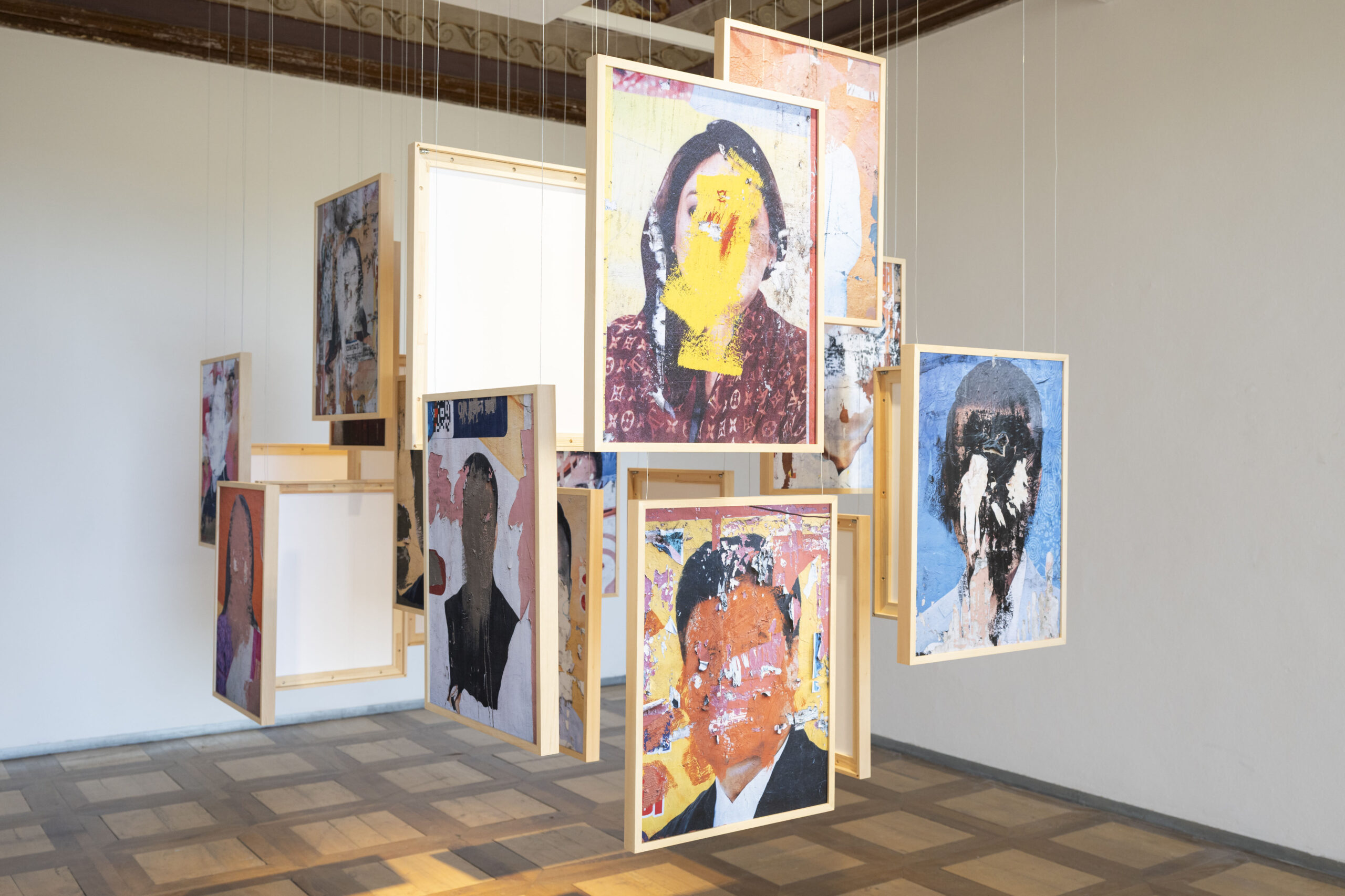
Uzma Mohsin’s installation Stick no Bills assembles election posters defaced by citizens, transforming them into a forest of suspended faces that reflects growing distrust in India’s democratic system.
Ishan Tankha’s two projects address conflicts surrounding land management and natural resources in India. In Submerged and A Peal of Spring Thunder, photography becomes a practice of testimony and political engagement, giving voice to marginalised communities.
With Behula, Those Days…, Ashfika Rahman creates a poetic archive of women’s stories gathered along the rivers between Bangladesh and India. The golden thread running through photographs and embroideries becomes a metaphor for connection, memory, and intergenerational transmission.
In the ongoing project Geographies of Water, Musuk Nolte observes climate change in the Amazon and the Andes through the lens of water, understood as an element capable of connecting environmental catastrophes and local forms of resistance within a transnational geography of transformation.
Finally, Alia Farid’s two videos explore territories marked by environmental and cultural tensions: the marshlands of Chibayish, between the Tigris and Euphrates rivers, threatened by the oil industry, and the Iranian island of Qeshm, where collective rituals and modernity coexist in a fragile balance. Through diverse yet deeply interconnected visual languages, Before it Happens offers a reflection on the present as a space of tension between loss and transformation, memory and future, denunciation and possibility.
The initiative is part of SNODI – Co-Creative Hills of Langhe Monferrato Roero, funded by the European Union through NextGenerationEU and managed by the Italian Ministry of Culture.