ISLAND OF SAN GIACOMO:
THE NEW VENUE OF THE FONDAZIONE SANDRETTO RE REBAUDENGO IN VENICE
Please be advised that it is currently not possible to access Isola di San Giacomo.
Access and booking information will be shared soon through our official channels.
We kindly ask you to wait for further updates.
Thank you!
A NEW VENUE, A NEW PROJECT
The Island of San Giacomo, in the Northern Lagoon of Venice, is the new venue of the Fondazione Sandretto Re Rebaudengo, a nonprofit institution for contemporary art founded in 1995. It joins the Turin headquarters, opened in 2002 in a former industrial area of the city; the Guarene site, with Palazzo Re Rebaudengo and its Art Park among the hills of the Langhe and Roero; and the Foundation’s itinerant presence in Spain, which is active through exhibitions promoted in the capital by Fundación Sandretto Re Rebaudengo Madrid. As with each of these venues, the identity of San Giacomo is shaped in close relation to its location and is distinguished by a unique program, developed in dialogue with the surrounding context and open to the international art cultural landscape that center in Venice thanks to the Biennales and the city’s rich offering of exhibitions by public and private institutions.
Purchased in 2018 by Patrizia Sandretto Re Rebaudengo and Agostino Re Rebaudengo from Cassa Depositi e Prestiti, San Giacomo has been transformed into an innovative laboratory for art and sustainability.
“In this strip of land surrounded by water,” says Patrizia Sandretto Re Rebaudengo, President of the Foundation, “I immediately recognized a special place, suited to hosting exhibitions, artworks, and residencies—perfect for accommodating the slower pace of artistic research and fostering dialogue and encounters among artists, theorists, and scholars from all disciplines.” As an integral part of the lagoon’s delicate ecosystem, the island has been reimagined to cultivate and develop ecological awareness and practices. In line with this vision, explains Agostino Re Rebaudengo, President of Asja Energy, “San Giacomo has been saved from abandonment through a unified restoration project that went beyond architectural renovation to structure the entire island as an ecosystem based on circular economy principles.”
The project for the Island of San Giacomo thus brings together, in a virtuous alliance, the Fondazione Sandretto Re Rebaudengo’s cultural programming—drawing on its thirty years of expertise—and the sustainability research activities of Asja Energy, a benefit corporation active for over 30 years in renewable energy production and CO₂ emissions reduction. The principles of environmental sustainability reinforce the fundamental role of art in promoting ecological awareness. The Island of San Giacomo is a unique example in Italy of the relationship between biomuseology and conservation, in line with the guidelines of the Ministry of Culture aimed at reducing the environmental impact of historic buildings and sites. At the same time, it aligns with the new definition of museum proposed by ICOM in 2022: an institution “at the service of society” that, alongside its traditional missions, “promotes diversity and sustainability.”
AN OPEN ISLAND
San Giacomo now becomes a meeting place for artists, scholars, researchers, art audiences, and citizens. In a context where many islands in the Venetian Lagoon have progressively lost their public function, San Giacomo stands out as a unique example of environmental, artistic, and cultural regeneration.
It is an open island: access is free, and all routes and spaces have been designed to be accessible to people with disabilities.
The site will open gradually. Initially, San Giacomo will be accessible during exhibition openings, coinciding with the Venice Biennales, and on the occasion of guided tours for groups organized by reservation. An agreement has been signed with the Municipality of Venice providing for an on-request stop at San Giacomo on ACTV Line 12 along the Murano–Burano route. A dock for waterbuses is currently under construction.
MAY 7, 2026: THE INAUGURAL PROGRAM
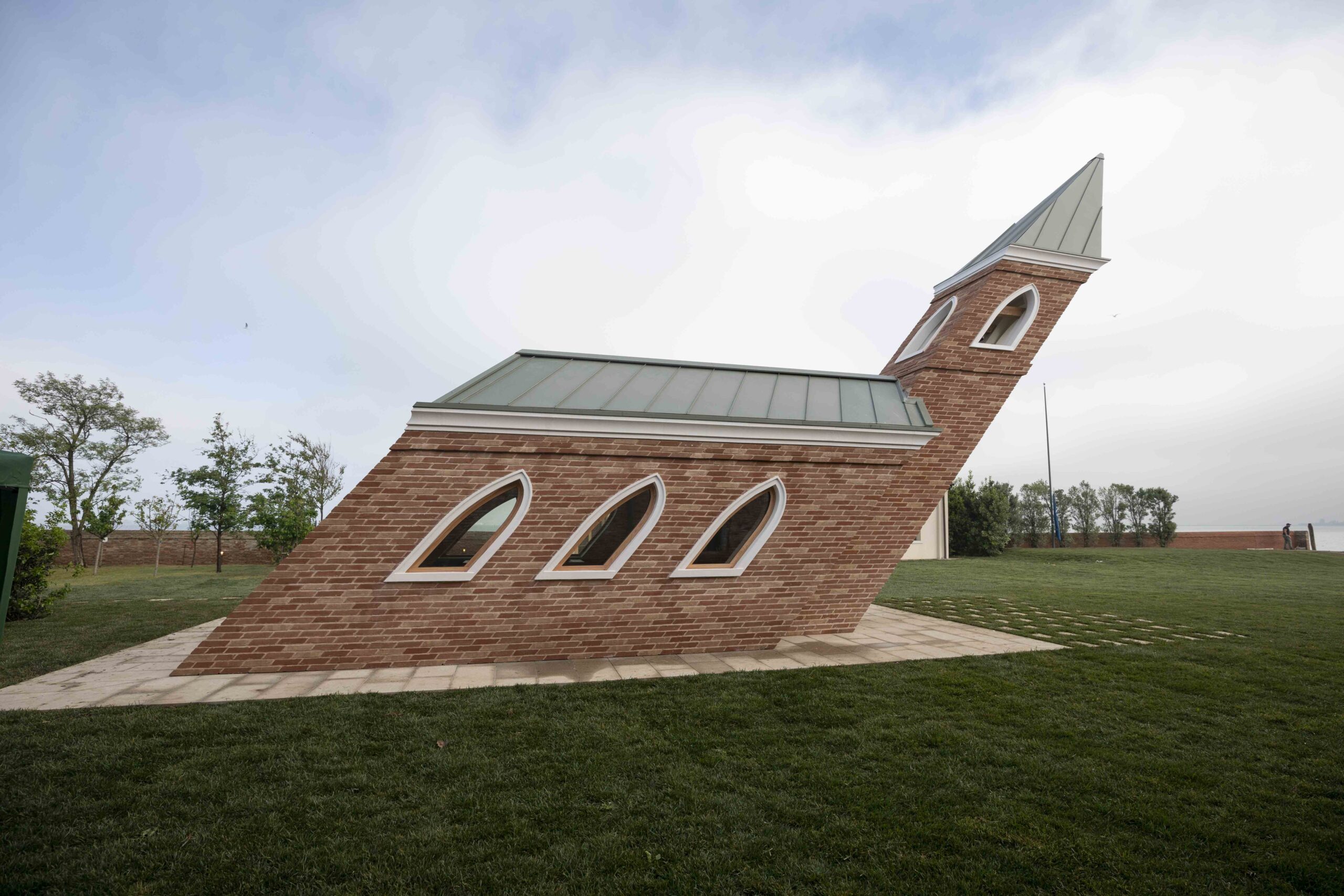
First opened to the public in April 2022 for a performance by Jota Mombaça, and again two years later during the ceremonial performance by Eun Me Ahn, the San Giacomo venue will officially inaugurate on May 7, 2026, with a rich program: Fanfare/Lament, a solo exhibition by Matt Copson, curated by Hans Ulrich Obrist; the group exhibition Don’t have hope, be hope!, featuring works from the Sandretto Re Rebaudengo Collection; Isola di San Giacomo 2022–2026, A Story in Images, a selection of photographs from the campaigns by Giovanna Silva and Antonio Fortugno documenting the restoration of the site; and the garden, with permanent installations by Claire Fontaine, Mario Garcia Torres, Hugh Hayden, Goshka Macuga, Pamela Rosenkranz, and Thomas Schütte.
Public access will be introduced progressively. Information on visiting and booking procedures will be announced soon.
Outdoor spaces and restored interiors guide visitors in discovering the island and its ancient history. Its various functions, layered over time, are reflected in the names of the buildings, beginning with the two Napoleonic-era Polveriere (powder magazines) now transformed into exhibition spaces with the hope that art may defuse a military past in favor of critical reflection on the present. The guesthouses, intended for residencies, still echo the site’s hospitable vocation; the vineyard recalls the orchards and cultivated gardens that once existed here; and the “Grotowski’s Trees” pay tribute to the theatre director and theorist of Poor Theatre, who in 1975, during the Venice Theatre Biennale, chose this wild location to prepare and stage Apocalypsis cum figuris.
THE HISTORY OF THE ISLAND OF SAN GIACOMO
In the heart of the Northern Venetian Lagoon, between Murano and Burano, lies an almost square-shaped island that for centuries has served as a place of passage, hospitality, spirituality, and defense. San Giacomo is a fragment of lagoon history spanning nearly a thousand years of human and architectural events, and today it is the protagonist of a rebirth that renews an identity deeply rooted in the past.
Within a lagoon context already crossed in the Middle Ages by trade routes between Venice and the Upper Adriatic, in 1046 Doge Orso Partecipazio Badoer granted the island for the construction of a monastery and a hospitable for pilgrims—a resting place open to travelers and sailors crossing the lagoon. In the following centuries, it became a female monastery: the Cistercian nuns, who lived here from 1238 to 1440, reclaimed the land, managed the water, cultivated the soil, and experimented with forms of agricultural self-sufficiency, marking one of the periods of greatest flourishing for the site. After their departure around 1440, the island changed function once again, first hosting a temporary lazaretto and later a settlement of Franciscan friars.
A radical turning point came with Napoleon’s arrival in Venice in 1797, marking the beginning of Napoleonic rule, followed in the 19th century by Austrian domination. Under Napoleon, the monastery was demolished and the Island of San Giacomo was transformed into a military outpost, later used by the Italian army. Religious architecture gave way to Polveriere, weapons depots, and defensive structures. After 1961, when military use ceased, the island entered a long period of abandonment: buildings overtaken by brambles, collapsed roofs, accumulated waste—a historical and environmental heritage progressively forgotten. Over time, also affected by erosion, San Giacomo has more recently been the subject of excavation and research campaigns that have brought to light artifacts and medieval structures, providing valuable insights into monastic life and the evolving use of its spaces.